Ghosts in the Field

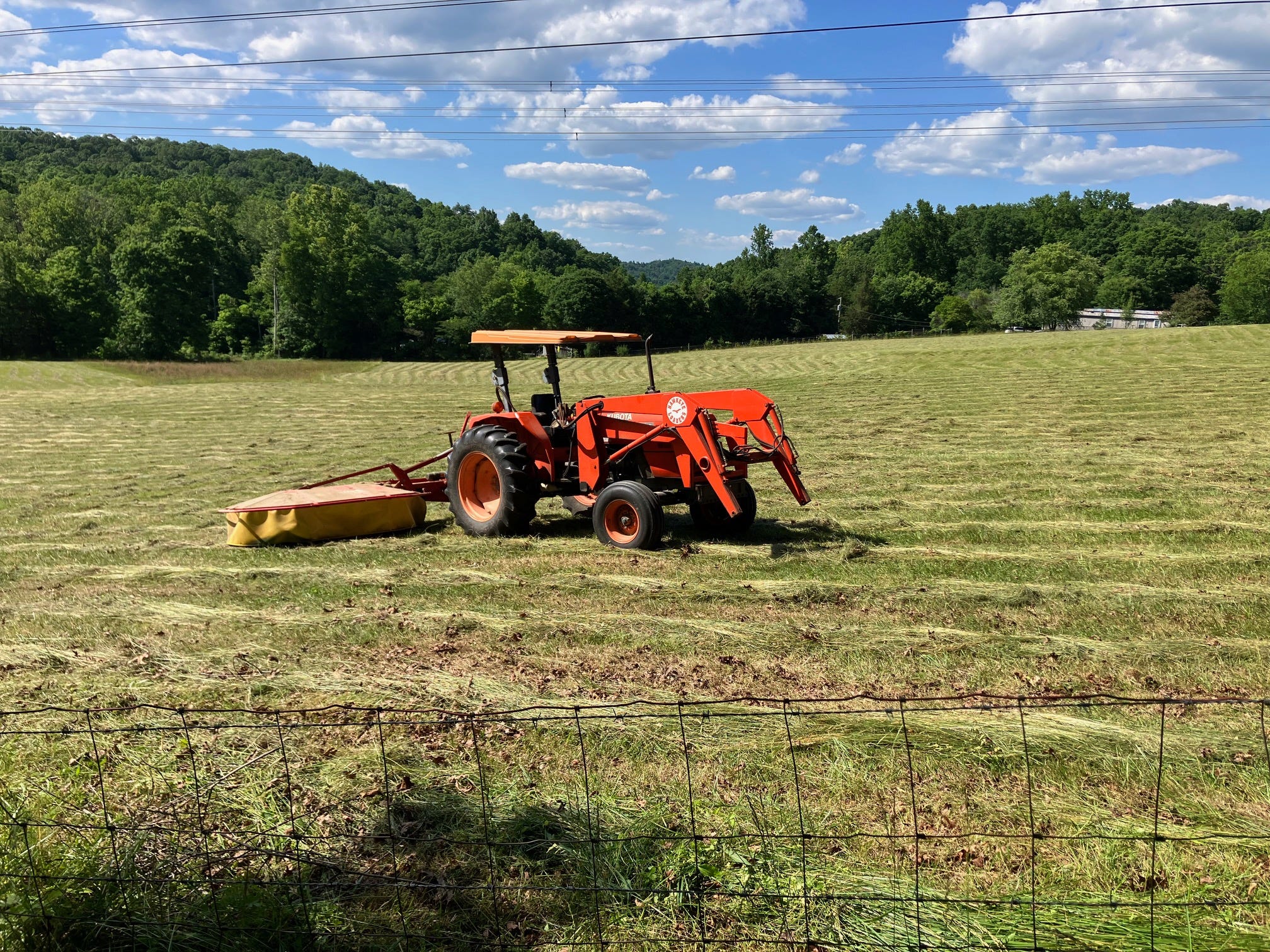
The original property lines of what we’ve called “Winged Elm Farm” for the past twenty-six years were surveyed in the classic English way of natural landmarks—from this boulder to that post, from an ancient white oak to that sycamore. The bygone method of land mapping is typical of the hill-and-mountain counties of Middle and East Tennessee, while the recognizable American grid prevails in the flat western counties. The historic system of surveying has left our farm’s boundaries looking less like a rectangle and more like a child’s first attempts on an Etch a Sketch.
Haying time in East Tennessee comes around roughly each Memorial Day and Labor Day. Of the thirty-five acres of bale-worthy land, each plot varies in size from one acre to twelve. For many years, I cut and baled up to eight different fields. The past few, I have focused on cutting only a ten-acre and a six-acre parcel, and this year I decided to use the lower pasture of six acres, next to the road, as the single hay field. There is a long explanation, but the short of it is that as the years have moved on, we have consciously reduced our farm operations to fit our personal energies and needs.
This past week, as I was mowing the lower field and then raking, baling, retrieving, and finally storing the harvest in the hay barn, I pondered past years’ cuttings on this same ground. I thought about all the neighbors that had bordered or lived close to the field. I thought most about Joe Kyle (whom we never considered calling anything but “Mr. Kyle”), how he and one of his three sons helped me get in an early harvest after my rake and baler broke. Both men are now dead, and Mr. Kyle is buried in the nearby Cedar Fork Baptist cemetery. I remembered the Moores, James and Marie, also gone, who let us know that time at dusk when our entire herd of cattle was out on the highway. And there was Donald Holt, buried at Fenders Methodist cemetery a few miles away, who would sometimes bring me a beer on a hot, dusty September day.
Haying is a solitary activity but, in this particular field, one done in view of the many. I recalled the day, as I cursed and kicked a broken Pitman rod on a sickle mower some twenty-five years ago, old Alex (which everyone pronounced “Eluc”) Bettis calling across the field to me and asking if he could help. Of course I said no, assuming in those early days of ignorance that to be self-reliant meant never accepting an offer of help. My, how I learned quickly to accept those offers (and return them). Alex too is long gone, laid out in his casket in a brand-new pair of overalls and buried a stone’s throw from Mr. Kyle.
To cut this field is to relive all the broken rakes, belts and chains come loose on the balers, exploding disc mowers, bearings melted into misshapen blobs, sickle bars broken, rivets replaced in the field—so many hay cuttings abandoned to aging and aged equipment failures. And to remember all those honest, caring, reliable neighbors. To cut hay is to work on equipment. To cut hay is also to work with the weather. Too little rain or too much rain or rain that shows up at the most inopportune time, in the midst of haying, either too early than predicted or totally unexpected, overnight after cutting, when I have awakened to the sound of a downpour on our tin roof. Such is hay season on the farm.
This week, all those cluttered memories swirling—the neighbors now dead, their children grown and moved away, the escaped cattle, the dead calf, the broken equipment, the rains and the droughts—I once again cut the lower field. Halfway through the task, as I rounded a corner pulling the baler over a windrow, the FedEx man drove slowly up our gravel driveway and, after dropping off a package, stopped to watch. A few minutes passed, and he gave a wave and drove off. An hour later our mail carrier pulled off the road at our mailbox, and she did the same.
Haying is repetitive and also meditative work. In spite of the minor breakdowns and major catastrophes, I have always found it to be very satisfying. In many ways, it has made me a part of the landscape and the history of this land. Given a couple more decades, I too will be a memory of someone else, a ghost in these fields that the farmer mows on a storm-threatened day.
Elegant and honest. Couldn’t ask for much else. 🖤
What a poignant essay. It reminds me of some great neighbors I had growing up, especially Leo, a gunner in a tank destroyer during the Battle of the Bulge. He was the best neighbor a fellow farmer could ask for, willing to help out a young farmer anyway possible. I always wondered how such a kind, meek man could pull the trigger. He blocked out all memories of the war. Rest in Peace you good man.